
Creative writing: Writing about writers
Author R.N. Morris describes what happened when he created a writer character in his new spy thriller

I’ve always had a prejudice against novels about writers. It just seemed a bit lazy to me. As if the author couldn’t be bothered to research, or imagine, any life other than their own.
There are obviously some great books with authors as characters. From George Gissing’s New Grub Street to Michael Chabon’s Wonder Boys. But there was no way I was going to add to the genre.
So you can understand my embarrassment when I actually found myself writing a book in which the central character is a writer. I really, really tried to resist it, I promise. But the idea took hold of me and there was nothing I could do. Eventually, I decided to lean into it. I had a lot of fun doing so, I can tell you.
The idea in question came to me after watching the French spy drama Le Bureau. The main character is a French spy working undercover as a professor of French literature in Syria. It’s decided that he will take a sabbatical from this, in order to return to Paris for a spell. The pretext is that he is working on a novel. A suitable work-in-progress has to be provided to support the cover story.
Et voilà, as if by magic, a hefty manuscript appears on the desk in his apartment. Now this can’t just be a pile of paper with random words typed on it. It has to pass muster as the kind of well-written, artistically interesting tome that a French professor of literature would write. Because as the DGSE (French equivalent of MI6) predict, the Syrian intelligence services break into his apartment to check that his story holds up.
Now Le Bureau is a great show, rightly celebrated for the authenticity of its storylines. The producers consulted with former DGSE officers to make sure they got every detail right.
But for some reason, in this particular instance, they didn’t provide any details at all.
For me as a writer, I was left with one big question. Who wrote that?
I wanted to know.
I wanted to know their background. Did they work for the DGSE or was the job outsourced to a trusted freelancer? Presumably they were paid for their work. How much? What’s the going rate for ghosting a novel for the security services?
Most of all I wanted to know how the writer felt about the fact that the book they were labouring on would never see the light of day. Unless the cover required that it was published, in which case it would be attributed to the spy rather than the true author.
Can you imagine working for months on a masterpiece, without ever being able to take the credit for it?
Le Bureau didn’t answer any of my questions so I decided to write my own story in which I explored them and came up with answers of my own. I transferred the setting to the UK, switching the DGSE to MI6.
In my novel, the writer in question is Col Newton. Ten years earlier, Col wrote a critically acclaimed commercial flop, a literary novel called Solstice. Out of the blue, Col is approached by an old university friend, Lazenby, who it turns out is an MI6 officer. Lazenby recruits Col to write a novel to provide cover for an agent who’s posing as a writer.
Given that his literary career is in the doldrums, Col accepts the challenge, and the generous fee which Lazenby is dangling in front of him. Knowing that he will never be credited as the author of the book turns out to be strangely liberating. Col finds himself writing the best thing he’s ever produced. And he grows increasingly reluctant to let Lazenby have it.
The tension cranks up when Col suspects Lazenby of murder and begins to think his own life might be in danger.
Of course, the problem with writing a book about a writer is that everyone assumes it’s autobiographical. ‘Is Col Newton you?’ is the question I always get asked whenever I get feedback from readers.
I do recognise some elements of myself in Col, though slightly exaggerated for comic effect. Col is paranoid, neurotic, insecure and obsessive. A typical writer, in other words. Do any of those adjectives describe me? Well, I will own up to sharing Col’s addiction to checking my Amazon ratings.
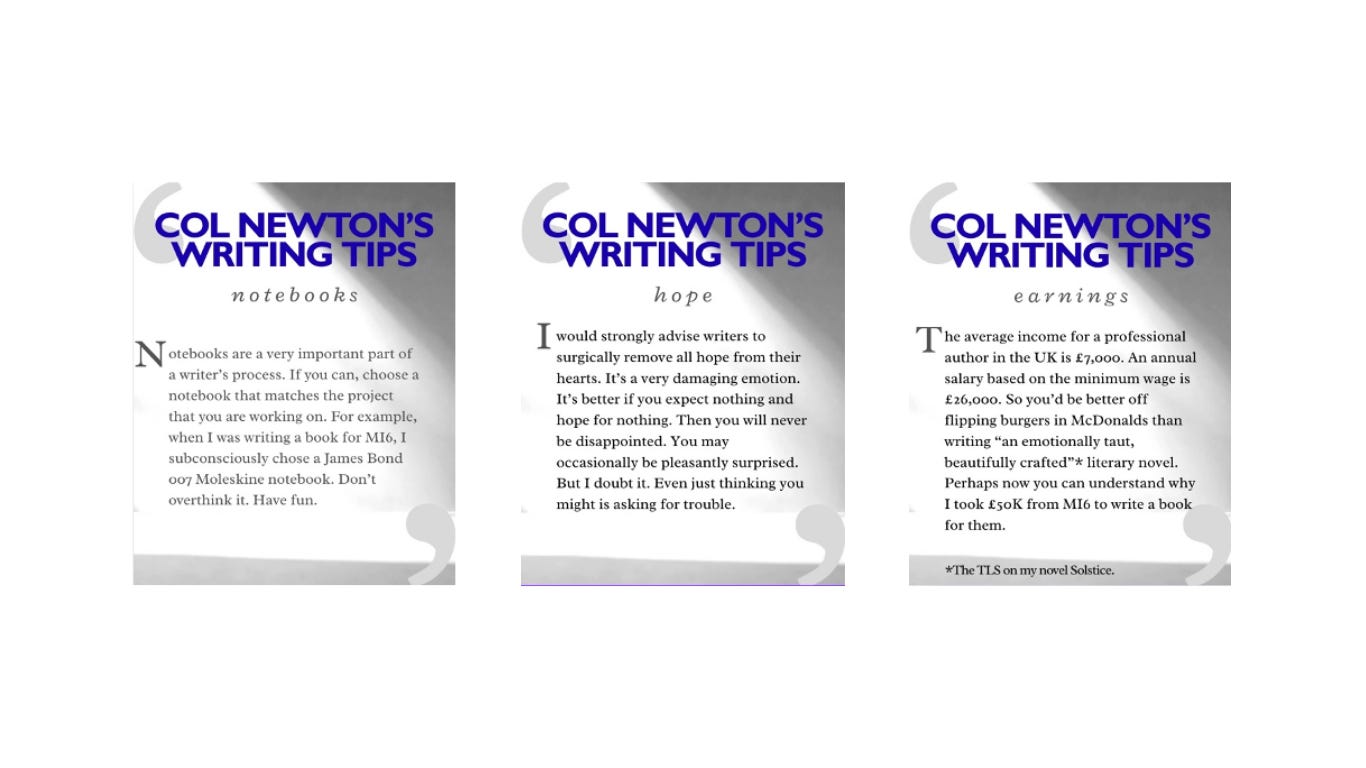
To help promote Cover Story, I had the idea of posting ‘Col’s Writing Tips’ on Instagram. The tips are tongue-in-cheek, and cover common writing topics in a way that reveal Col’s character and story.
Want more writing tips? Check out this definitive guide to writing genres
People seemed to like them. They made Col seem like a person in his own right, someone who existed outside of the pages of my novel. So much so that when I googled ‘who is writer Col Newton?’, the AI overview informed me: ‘Col Newton is a writer and blogger known for sharing “writing tips” and humorous, often eccentric, insights on the craft, appearing in contexts related to author Roger Morris. He focuses on aspects like elevator pitches, writing rituals, and the psychology of creativity, often sharing these via Instagram.’
There was no mention of him being a fictional character. For me as a writer, it felt like job done. I had convinced the world – well, AI at least - that one of my characters was real.
I always of lazy writing when a writer creates a main character who is a writer but I've realized it's not. I will explore one in my writing some time.
The writer-character in your novel is interesting.
Hello again here Orli from Worldy-TCP, I have send you a private message on the app, please if you could reply to your convenience. Thank you 🙂